
How Long Does Nicotine Stay in Your System? Test Windows
Table of Contents
- Key Takeaways
- Nicotine Detection Times at a Glance
- How Does Your Body Break Down Nicotine?
- How Long Does Nicotine Stay in Your Blood and Saliva?
- How Long Does Nicotine Stay in Urine?
- How Long Does Nicotine Show Up in Hair?
- What Is a Cotinine Test?
- Does Vaping Show Up on a Nicotine Test?
- What Affects How Long Nicotine Stays in Your System?
- Why Would You Get a Nicotine Test?
- How to Pass a Nicotine Test: What the Science Says
- Want to Vape Without Nicotine?
- FAQs
How long does nicotine stay in your system? Nicotine itself has a half-life of about 2 hours, so it clears within hours. Cotinine, the main breakdown product tests look for, lasts much longer: usually around 3 to 4 days in blood, saliva and urine, sometimes a week or more, and months in hair.
Key Takeaways
- Nicotine has a half-life of about 2 hours. Cotinine averages about 16 hours, but ranges from 8 to more than 30 hours depending on the person.
- Most nicotine tests look for cotinine, not nicotine, because it sticks around much longer.
- Vapers and smokers test the same. Researchers report cotinine levels are "quite similar" in regular vapers and cigarette smokers.
- Nicotine pouches, gum, patches and lozenges all contain nicotine and can produce a positive cotinine result.
- Genetics, pregnancy, sex and how much nicotine you use all change how fast your body clears it.
- There is no reliable shortcut. The only dependable way to test negative is to stop using nicotine long enough for cotinine to drop.
Nicotine Detection Times at a Glance
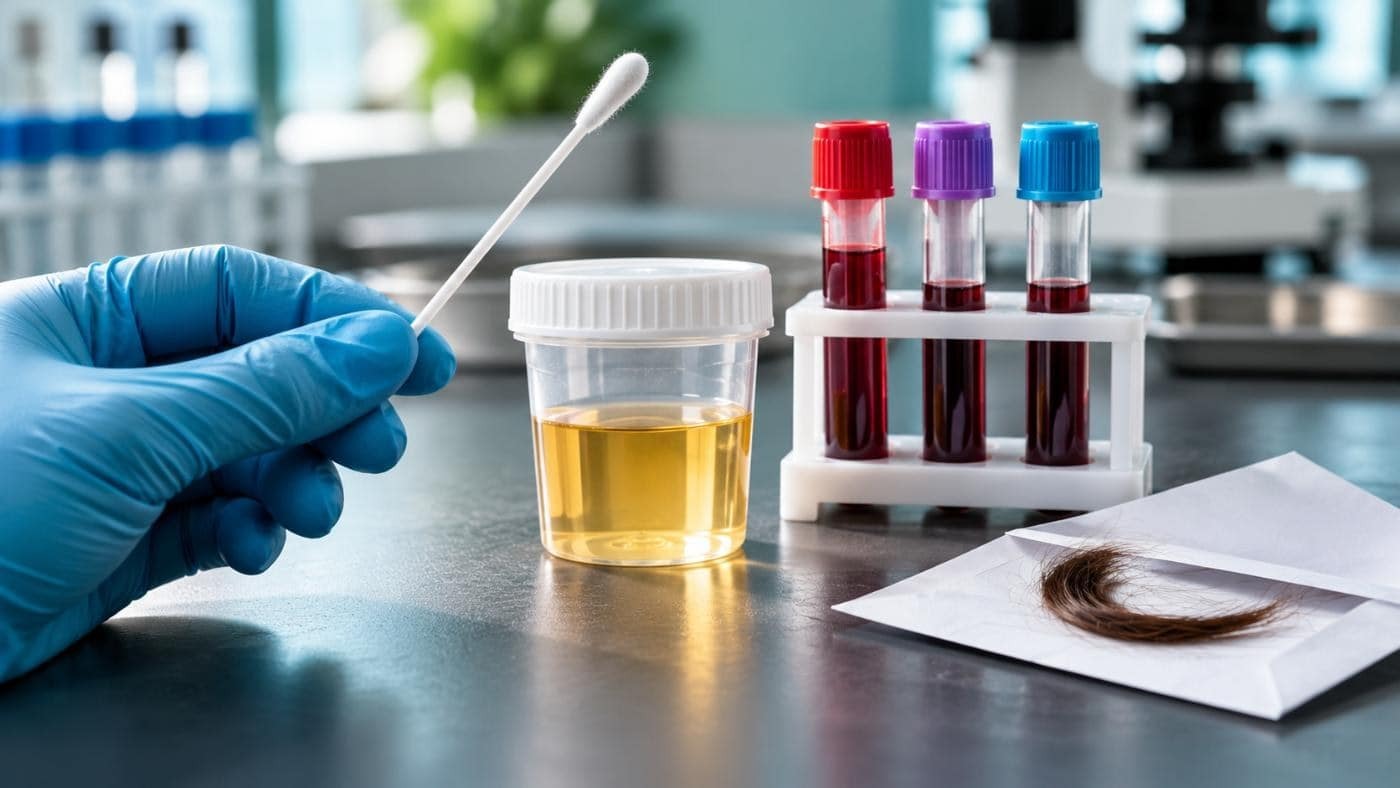
| Test type | What it usually measures | Typical detection window |
|---|---|---|
| Blood (serum or plasma) | Cotinine, sometimes nicotine | Nicotine: hours. Cotinine: about 3 to 4 days on average, up to about 6 days in slow metabolizers |
| Saliva | Cotinine | Similar to blood, about 3 to 4 days on average |
| Urine | Cotinine | Several days. Medical references say levels can take 7 to 10 days, or longer, to return to normal |
| Hair | Nicotine and cotinine | Months, depending on how much hair is tested (hair grows about 1 cm per month) |
These are typical ranges, not guarantees. Labs use different cutoff levels, and your own metabolism matters a lot.
How Does Your Body Break Down Nicotine?
When you vape, smoke or use a pouch, nicotine enters your bloodstream and your liver gets to work on it right away. A liver enzyme called CYP2A6 converts about 80% of nicotine into cotinine, according to a 2021 review in Frontiers in Pharmacology.
That conversion is the reason tests focus on cotinine. Nicotine has a half-life of about 2 hours, meaning half of it is gone roughly every 2 hours. Cotinine has an average half-life of about 16 hours, per the Society for Research on Nicotine and Tobacco (SRNT) guidance on biochemical verification of tobacco use. That longer half-life gives labs a much wider window to detect recent use.
Nicotine vs. Cotinine Half-Life
| Compound | Average half-life | What that means for testing |
|---|---|---|
| Nicotine | About 2 hours | Drops fast, so it only shows very recent use |
| Cotinine | About 16 hours (range 8 to 30+ hours) | Builds up with regular use and lingers for days |
How Long Does Nicotine Stay in Your Blood and Saliva?
Nicotine itself leaves your blood within hours. Cotinine is a different story. The SRNT guidance estimates that once a regular user stops, it takes about 40 hours for cotinine to fall below a typical cutoff in people with a fast 8 hour half-life, about 90 hours at the average 16 hour half-life, and about 150 hours for slow metabolizers with a 30 hour half-life.
Because of that spread, the guideline says it is reasonable to allow 6 to 7 days of no nicotine before treating someone as a nonsmoker. Saliva and blood give similar results, so the same timing applies to a mouth swab test.
How Long Does Nicotine Stay in Urine?
Urine has the highest concentration of cotinine of the common sample types, which makes it the most sensitive test. That is a big reason urine is so common for insurance and workplace screening.
Hospital references give a slightly longer real-world range than the half-life math alone. Cedars-Sinai says that after 7 to 10 days with no nicotine, cotinine levels start returning to normal. Michigan Medicine notes it can take more than 2 weeks for cotinine in blood and urine to drop after you stop.
How Long Does Nicotine Show Up in Hair?
Hair works differently. As hair grows, it traps nicotine and cotinine, and those compounds are not broken down once they are locked in. Hair grows about 1 cm per month on average, and researchers writing in Scientific Reports describe hair as a good estimate of averaged exposure over a period of more than a month.
In plain terms, a hair test looks back over months, not days. How far back depends on how long a segment of hair the lab tests.
What Is a Cotinine Test?
A cotinine test measures the amount of cotinine in your blood, urine or saliva. Results are compared to a cutoff. The SRNT guideline lists typical cutoffs of about 3 to 10 ng/mL for blood, around 12 ng/mL for saliva in one large study, and about 30 to 50 ng/mL for urine.
Those cutoffs exist partly to separate users from people around them. Secondhand smoke exposure usually produces serum cotinine below 3 ng/mL, while daily smokers typically average 100 to 250 ng/mL. A positive result means you have nicotine in your system. It does not tell the lab what product it came from.
Does Vaping Show Up on a Nicotine Test?
Yes. If your vape contains nicotine, you will test positive the same way a smoker would. The SRNT guidance states that cotinine levels are quite similar in regular vapers and cigarette smokers, and it calls cotinine "not useful" for telling vapers apart from smokers because e-cigarettes are nicotine delivery devices.
The type of nicotine does not change that. Tobacco-derived and synthetic nicotine are the same molecule, which we explain in What Is Synthetic Nicotine? Your liver turns both into cotinine.
How much you vape matters for how much cotinine builds up. If you want a sense of how vape use compares to cigarettes, see how many puffs of a 20mg vape equal a cigarette and how many packs of cigarettes are in a vape.
Do Nicotine Pouches and Gum Show Up Too?
They do. Nicotine pouches, gum, lozenges and patches all deliver nicotine, and the SRNT guidance notes that cotinine reflects nicotine from all sources, including replacement products. Cedars-Sinai and Michigan Medicine both warn that gum or a patch can affect or cause a positive result. If you are curious how pouches deliver nicotine, read how nicotine pouches work or our ZYN vs. vape comparison.
What Affects How Long Nicotine Stays in Your System?
Two people who use the same amount of nicotine can test very differently. Here are the factors supported by research:
| Factor | What the research says |
|---|---|
| Genetics | Variants of the CYP2A6 gene slow nicotine and cotinine breakdown. SRNT notes these slow variants are more common in people of Asian and African American ancestry. |
| Pregnancy | Clearance of nicotine and cotinine runs about 60% and 140% higher in pregnant women, per Frontiers in Pharmacology. |
| Sex and hormones | Women clear nicotine and cotinine faster than men on average, and estrogen boosts CYP2A6 activity. |
| How much you use | Daily users build up far higher cotinine levels than occasional users, so it takes longer to drop below a cutoff. |
| Test type and cutoff | Urine is the most sensitive common test. Hair covers months. Lower cutoffs catch smaller amounts. |
Because the cotinine half-life can range from 8 to more than 30 hours, any single "you will be clean in X days" number is a rough guess at best.
Why Would You Get a Nicotine Test?
The most common reasons include:
- Life and health insurance. Some insurers require a cotinine test as part of a health exam before approving a policy.
- Employment. Some employers that prohibit tobacco or nicotine use test applicants.
- Surgery. Nicotine impairs wound healing, and a study in Plastic and Reconstructive Surgery measured urine nicotine and cotinine in cosmetic surgery patients because undisclosed use may raise complication risk.
- Quit programs and research. Cotinine tests are used to confirm progress in stop-smoking programs and clinical studies.
How to Pass a Nicotine Test: What the Science Says
People search this a lot, so here is the plain answer. The science does not support any shortcut. Cotinine leaves your body on your liver's schedule, and that schedule depends mostly on genetics and how much you have been using.
The only reliable way to test negative is to stop all nicotine, including vapes, cigarettes, pouches, gum and patches, long enough for cotinine to fall below the lab's cutoff. Based on the sources above, that is often around a week for blood, saliva and urine, sometimes longer for heavy users or slow metabolizers, and months for a hair test. If you have a test coming up for insurance, a job or surgery, being upfront about your nicotine use is usually the better path than guessing at timing.
Want to Vape Without Nicotine?
If you like the hand-to-mouth habit and flavor but want to cut nicotine out, nicotine-free vapes are an option. They contain no nicotine, so they do not add nicotine or cotinine to your system. Browse our nicotine-free vapes, or check our vape juice selection, where you can look for 0mg nicotine options. Keep in mind that nicotine pouches, gum and other "smoke-free" products still contain nicotine.
How we sourced this: We reviewed peer-reviewed research on nicotine and cotinine metabolism and testing, including the Society for Research on Nicotine and Tobacco's biochemical verification guidance published in Nicotine and Tobacco Research and hosted by the CDC, studies in Scientific Reports, Frontiers in Pharmacology and Plastic and Reconstructive Surgery, and patient lab test references from major US hospital systems. This article is for general information and is not medical advice.
This content is for adults 21 and older.
FAQs
1) How long does nicotine stay in your system after one vape?
Nicotine itself is mostly gone within hours, since its half-life is about 2 hours. A single session produces much less cotinine than daily use, so it usually clears faster, but no source gives a reliable exact number for one-time use.
2) Is a cotinine test the same as a nicotine test?
Most of the time, yes. Labs usually test for cotinine because it lasts far longer than nicotine, so a "nicotine test" is often a cotinine test under the hood.
3) Can a nicotine test tell if I vape or smoke?
Not with cotinine alone. Vapers and smokers have similar cotinine levels. Research labs can look for other tobacco-specific markers when they need to tell the difference.
4) Will secondhand smoke make me fail a nicotine test?
It is unlikely under normal conditions. Secondhand smoke exposure usually produces very low cotinine levels, well below the cutoffs labs use to flag active users.
5) Do nicotine-free vapes show up on a cotinine test?
Products that truly contain no nicotine do not produce cotinine. Check the label and stick with products clearly marked 0mg or nicotine-free.
6) Does drinking water flush nicotine out faster?
No source supports water or detox drinks speeding up cotinine clearance. Your liver breaks down nicotine at its own rate, so time without nicotine is what matters.
7) How long should I stop nicotine before a test?
Research guidance suggests about 6 to 7 days is a reasonable window for blood, saliva and urine in many people, though heavy users and slow metabolizers can take longer. Hair tests look back months.
Latest News

History of Vaping: When Were Vapes Invented?
Quick AnswerModern vapes were invented in 2003 by Hon Lik, a pharmacist in Beijing, China. His e-cig...

Velo vs Zyn vs On!: Strengths, Flavors and FDA Status
Table of Contents Key Takeaways Velo vs Zyn vs On! at a Glance Velo vs Zyn: What Is the Difference...

Elf Bar Flavors: EBCreate BC Pro 40K Full Flavor Guide
Table of Contents Key Takeaways EBCreate BC Pro 40K at a Glance What Is Elf Bar's New Name? Is Los...

Best Watermelon Ice Vapes: 10 Top Disposables in 2026
Table of Contents Key Takeaways Watermelon Ice Vapes at a Glance What Does Watermelon Ice Taste Li...

What Is Metatine? 6-Methyl Nicotine in SBX Vapes Explained
Table of Contents Key Takeaways Metatine at a Glance What Is Metatine Made Of? Metatine vs Nicotin...

Are Nicotine-Free Vapes Safe? What's Inside a 0mg Vape
Table of Contents Key Takeaways Nicotine-Free Vapes at a Glance What Is a Nicotine-Free Vape? What...