
What Is Metatine? 6-Methyl Nicotine in SBX Vapes Explained

Table of Contents
Metatine is a trade name for 6-methylnicotine (also written 6-methyl nicotine or 6MN), a lab-made nicotine analog used in SBX and Spree Bar disposable vapes in place of nicotine. It acts on the same brain receptors as nicotine, but it is a different molecule, which is why its regulatory status is still unsettled.
Key Takeaways
- Metatine is the brand name Charlie's Holdings uses for 6-methylnicotine, a nicotine molecule with one extra methyl group attached.
- Because it is not chemically nicotine, the 2022 federal law covering "nicotine from any source" does not clearly reach it.
- Research is limited. Some animal and cell studies report stronger or more toxic effects than nicotine, while others report similar effects.
- Germany's federal risk agency said in 2026 that a health risk assessment of 6-methylnicotine is not possible yet.
- States are moving: Indiana banned nicotine analog products starting July 1, 2025, and California added analogs to its flavor ban.
- No study has shown Metatine is safer or less addictive than nicotine.
Metatine at a Glance
| Item | Details |
|---|---|
| Chemical name | 6-methylnicotine (6MN) |
| Formula | C11H16N2 (nicotine is C10H14N2) |
| Type | Nicotine analog (structurally similar, not identical) |
| Brand owner | Charlie's Holdings, maker of Spree Bar and SBX |
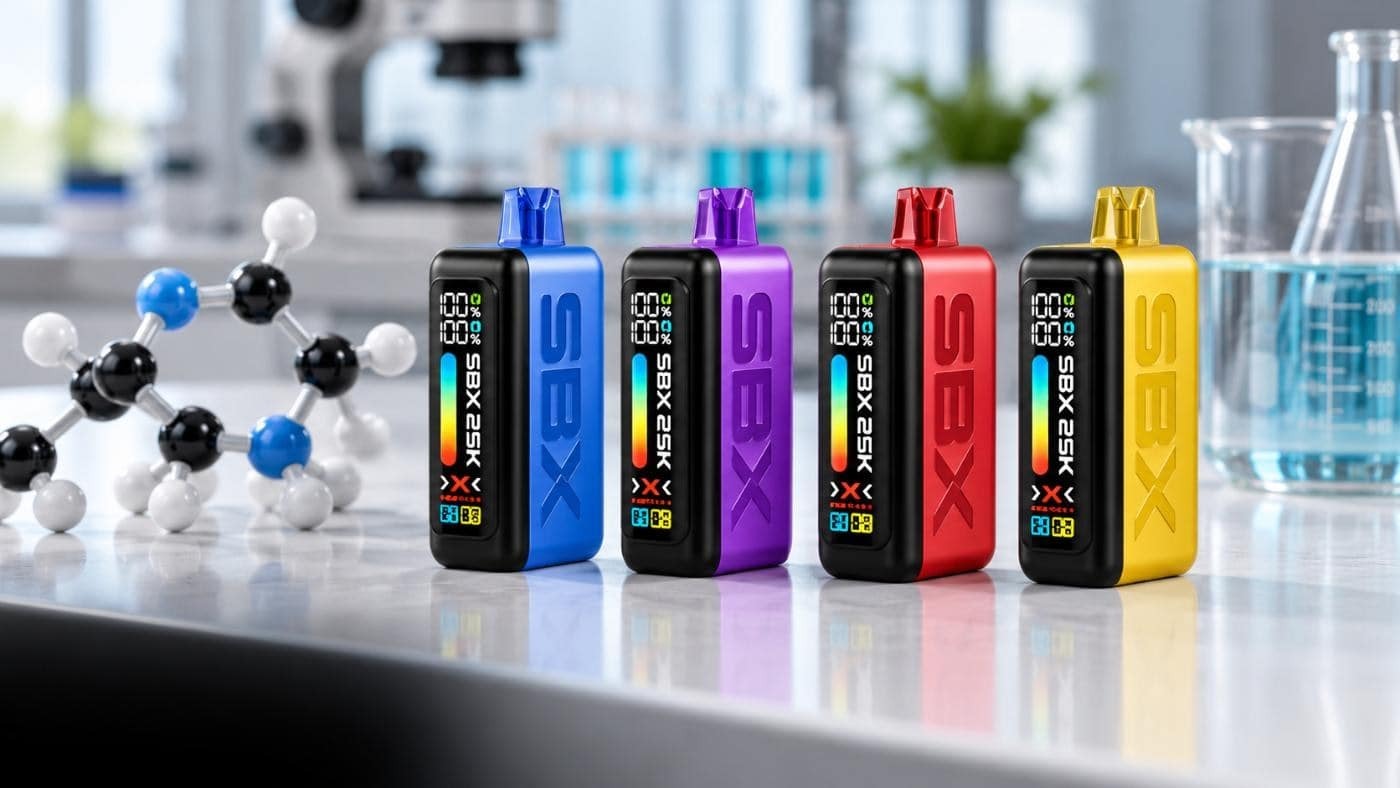
| Where you see it | SBX Metatine 25K and Spree Bar disposables |
| Other trade names for 6MN | Imotine, Nixodine, and others |
| Federal status | Not clearly covered by FDA tobacco rules; FDA said in 2024 it was reviewing data |
| Human research | Very limited |
What Is Metatine Made Of?
Metatine is 6-methylnicotine. Picture a regular nicotine molecule, then add a single methyl group (one carbon with three hydrogens) to position 6 of its pyridine ring. That small change gives a different molecule with the formula C11H16N2 instead of nicotine's C10H14N2.
The compound is not new to chemists. Researchers described making methylnicotine variants in the 1960s, and tobacco companies studied nicotine analogs for decades. What is new is selling it in consumer vapes. Spree Bar disposables using Metatine reached the US market in late 2023, and Charlie's Holdings announced the SBX line in October 2024, describing it as featuring "patented Metatine."
Charlie's Holdings itself does not print "6-methylnicotine" in its SBX launch release. The link comes from Reuters reporting in May 2024, which said the company calls the 6-methyl nicotine solution in Spree Bar "Metatine," and from public health law and research groups that list Metatine as a 6MN brand name.
One more twist: a 2025 study in Scientific Reports found 6-methylnicotine naturally present in cured tobacco at very low levels, about 0.32 micrograms per gram, or roughly 1 part for every 37,000 parts nicotine. The authors noted this could complicate claims that 6MN products have nothing to do with tobacco.
Metatine vs Nicotine: What Is the Difference?
Nicotine from tobacco and synthetic nicotine are the same molecule. Synthetic nicotine is just made in a lab instead of extracted from the plant. If you want the background on that, see our guide to what synthetic nicotine is. Metatine is different because the molecule itself is changed.
| Tobacco-derived nicotine | Synthetic nicotine | 6-methylnicotine (Metatine) | |
|---|---|---|---|
| Formula | C10H14N2 | C10H14N2 | C11H16N2 |
| Same molecule as nicotine? | Yes | Yes | No, one added methyl group |
| Source | Extracted from tobacco | Made in a lab | Made in a lab (also found in trace amounts in tobacco) |
| FDA tobacco authority | Yes, since 2009 law | Yes, since the 2022 "any source" update | Unclear; not named in federal law |
| Needs FDA marketing authorization to be sold legally? | Yes | Yes | Makers argue no; regulators have not settled it |
| Research base | Decades of human studies | Same molecule, same pharmacology | A small number of lab, animal and product studies |
| Human data | Extensive | Extensive (as nicotine) | Very limited |
Nicotine in vapes also comes in different forms, like freebase and salt. Those are formulation choices, not different molecules. Our posts on what salt nicotine is and nicotine salts vs freebase cover that side.
Is Metatine Stronger Than Nicotine?
The studies do not agree, and most are small.
- Receptor studies: A 1998 lab study found 6-methylnicotine bound nicotinic receptors more strongly than nicotine, with roughly three times the potency, as summarized by researchers in the Medical Journal of Australia in 2024.
- Animal studies reviewed by Germany's BfR: In functional studies in rats and mice, 6-methylnicotine "consistently showed a 2- to 5-fold stronger effect than nicotine," according to the German Federal Institute for Risk Assessment's February 2026 opinion. The same review said receptor binding results conflict and overall show no major difference.
- A 2026 rat study: Researchers publishing in Pharmacology, Biochemistry and Behavior found that equal doses of 6-methylnicotine and nicotine produced similar effects on body temperature, activity and pain response in middle-aged female rats, and similar vapor self-administration.
- FDA: In a May 2024 statement to Reuters, the FDA said "some emerging data show these nicotine analogs may be more potent than nicotine," while noting more research is needed.
Bottom line: some data point to stronger effects, some point to similar effects, and none show it is weaker or non-addictive.
Is Metatine Safe?
No one can say yet. The BfR opinion said "the data on 6-methylnicotine is very sparse," most studies were industry-funded, and "a health risk assessment is therefore not possible at present." Here is what the published research reports:
- A 2025 study in Toxicology Letters found heated 6MN e-liquids produced more reactive oxygen species in aerosol than nicotine e-liquids, and caused more cell damage in human bronchial cells grown in a lab.
- A 2026 study in Toxicology using a 3D model of human airway tissue found aerosols from 6MN and nicotine products caused similar tissue changes, and the authors suggested flavorings may drive much of the effect in both.
- The BfR noted an industry-funded rat study that reported a lethal dose 1.5 to 3 times lower than nicotine's.
These are cell and animal results, not human outcomes. For a broader look at how products marketed as alternatives to nicotine are judged, see our post on whether nicotine-free vapes are safe.
What Is Still Unknown About Metatine
- Human effects: The BfR found the only human data were a small industry patent study and a urine study of two people. An independent human study on addictive potential is underway in Munich.
- Inhalation toxicity: No valid data exist on long-term inhalation of 6MN, per the BfR.
- How the body handles it: How 6MN is absorbed and broken down in people is not well studied.
- Real product strength: Independent tests of Spree Bar have not matched the label. A 2024 study in JAMA found devices labeled 50 mg/g contained about 6 mg/g, and a 2026 Tobacco Control study measured about 0.3% against a 5% claim, with no nicotine detected. We found no published independent test of SBX devices specifically.
- Addiction: Whether it is more, less or equally addictive in people has not been established.
Is Metatine Legal? The Regulatory Picture
Federal law
Congress updated the Tobacco Control Act in 2022 so the FDA could regulate products "containing nicotine from any source," which brought synthetic nicotine under the same rules as tobacco nicotine. The catch is that federal law defines nicotine by its specific chemical identity. 6-methylnicotine is a different molecule, so it is not clearly covered.
Charlie's Holdings says Metatine "is not a tobacco product as defined in the Food, Drug and Cosmetic Act." The FDA has not publicly agreed or disagreed with that position for 6MN. Its most recent public statement we found, from May 2024, said the agency was "reviewing the available data to inform potential actions in this space." For the bigger picture on federal enforcement, see our breakdowns of the FDA vs flavored vapes Supreme Court decision and US disposable vape rules.
State laws
| State | Action | Status |
|---|---|---|
| Indiana | Bans selling any product containing a nicotine analogue (House Enrolled Act 1275) | In effect since July 1, 2025 |
| California | AB 3218 added nicotine analogs to the legal definition of nicotine, so the state flavor ban applies | Signed September 28, 2024 |
| Nebraska | LB9 taxes nicotine analogue products | Enacted 2025 |
| Louisiana | HB 782 would add "nicotine analogue" to vapor product definitions | Introduced in 2026 session |
Indiana's enrolled act defines a nicotine analogue broadly: a substance with a structure substantially similar to nicotine, or one that has or claims an effect on the central nervous system similar to or greater than nicotine. Selling one is a Class C misdemeanor. Local rules can also apply; Denver, for example, includes analogs in its flavor restriction. Rules change quickly, so check your state before buying.
SBX Metatine 25K: Flavors in Stock
For adults who want to see what SBX offers, here are the facts from our product listing. The SBX Metatine 25K holds 20 mL of e-liquid labeled at 50 mg (5%) Metatine, rated for up to 25,000 puffs in ECO mode. It has a dual mesh coil, a 1000 mAh USB-C rechargeable battery, three power modes (ECO 15W, Boost 20W, X 25W), adjustable MTL, Normal and DTL airflow, and a full-color screen showing battery, e-liquid level, mode and puff count. Our SBX Metatine 25K review goes deeper on performance.
Flavors currently in stock:
- Blue Razz Ice
- Blueberry Burst
- Clear (unflavored)
- Grape Ice
- Lemon Apple Ice
- Ripe Apple
- Strawberry Kiwi
- Sweet Spearmint
- Virginia Tobacco
Mystic Ice is part of the lineup but is currently out of stock. You can also browse all disposable vapes. Check your state and local rules on nicotine analogs before ordering.
How we sourced this: We checked peer-reviewed studies indexed on PubMed (Toxicology Letters, Toxicology, Pharmacology, Biochemistry and Behavior, JAMA, Tobacco Control, Medical Journal of Australia, Scientific Reports), the German Federal Institute for Risk Assessment's 2026 opinion, FDA statements reported by Reuters, the Indiana General Assembly's enrolled act, California and Nebraska legislative summaries from public health and policy sources, the manufacturer's SBX launch release, and our own SBX product listing.
This content is for adults 21 and older.
FAQs
Is Metatine the same as nicotine?
No. Metatine is 6-methylnicotine, which has one extra methyl group compared with nicotine. It acts on the same receptors in the brain, but it is a separate chemical.
Is Metatine synthetic nicotine?
Not in the legal or chemical sense. Synthetic nicotine is the exact nicotine molecule made in a lab, while Metatine is a modified version of that molecule. That difference is why synthetic nicotine falls under FDA tobacco rules and Metatine's status is unclear.
Is Metatine addictive?
Researchers have not established that in humans yet. Animal data reviewed by Germany's BfR suggest it may be more addictive than nicotine, and no study shows it is non-addictive.
Who makes Metatine?
Metatine is a trademark of Charlie's Holdings, the company behind Spree Bar and SBX disposables. Other companies sell 6-methylnicotine under names such as Imotine and Nixodine.
Will Metatine show up on a nicotine test?
Standard nicotine tests look for nicotine and its breakdown products, and 6MN is a different compound. Australian researchers reported that some 6MN vape makers advertised their products as passing routine nicotine testing, but how 6MN shows up on drug screens has not been well studied.
Is Metatine legal in every state?
No. Indiana bans the sale of nicotine analog products, and California applies its flavor ban to them. Other states and cities are adding analogs to their tobacco laws, so local rules matter.
Does the FDA regulate Metatine?
Not clearly. The 2022 law covers nicotine from any source, but 6-methylnicotine is not nicotine by chemical definition. The FDA said in 2024 that it was reviewing the data.
Latest News
History of Vaping: When Were Vapes Invented?
Quick AnswerModern vapes were invented in 2003 by Hon Lik, a pharmacist in Beijing, China. His e-cig...
Velo vs Zyn vs On!: Strengths, Flavors and FDA Status
Table of Contents Key Takeaways Velo vs Zyn vs On! at a Glance Velo vs Zyn: What Is the Difference...
Elf Bar Flavors: EBCreate BC Pro 40K Full Flavor Guide
Table of Contents Key Takeaways EBCreate BC Pro 40K at a Glance What Is Elf Bar's New Name? Is Los...

Best Watermelon Ice Vapes: 10 Top Disposables in 2026
Table of Contents Key Takeaways Watermelon Ice Vapes at a Glance What Does Watermelon Ice Taste Li...
What Is Metatine? 6-Methyl Nicotine in SBX Vapes Explained
Table of Contents Key Takeaways Metatine at a Glance What Is Metatine Made Of? Metatine vs Nicotin...
Are Nicotine-Free Vapes Safe? What's Inside a 0mg Vape
Table of Contents Key Takeaways Nicotine-Free Vapes at a Glance What Is a Nicotine-Free Vape? What...